OSC communication
What the messages mean. Every port is on Ports and endpoints.
Where addresses and ports live
Every OSC address, port and IP is written once, in a3-osc.json, in two
parts:
Part |
Owner |
Where |
|---|---|---|
contract: addresses, arguments, senders, listeners, ports, routes, VU map |
the a3-core package, replaced on every install |
|
network: |
the maintainer; created once by the installer, never overwritten |
|
Core joins them key by key; network.json wins, missing hosts come from
the package. A network.json that does not parse or lacks hosts or network
is refused (reason in the journal) and the package’s values are used.
Core serves the result at http://<core>:9080/api/truth (core.web). Header
X-A3-Truth is its fingerprint: sha256 of the canonical JSON (sorted keys,
no spaces, UTF-8).
Section |
Holds |
|---|---|
|
Core’s interface, address, gateway, DNS, and the audio socket ( |
|
machines by name: |
|
program, role, host, port |
|
who sends to which listener |
|
pattern, types, sender, hearer, meaning |
|
the forty meters by name, in |
|
REAPER’s and the IEM plug-ins’ words |
The tables here and on the ports page are rendered from it.
Who reads it, and how
Device |
How it gets the truth |
|---|---|
A³ Core |
the package’s contract joined with |
A³ Motion |
fetches it from Core, shared cache |
A³ Mixer |
fetches it from Core on |
StemDeck |
like Motion; reads |
beat-analyzer |
the |
AES67 sender |
|
installer |
offers the package’s |
Core will not start without the package’s file (or
$A3_OSC_TRUTH).Core announces itself every 2 s:
/core/herebroadcast ondevices.announce, with the/api/truthURL, the fingerprint and a boot id (new with every Core start, so a device notices even a very quick restart). Broadcasts don’t cross routers; a device on another subnet uses~/.config/a3/core(radla).
Following Core: StemDeck and A³ Motion
Both run on the Core as aaa, share the cache and listen for /core/here. At
start each takes $A3_OSC_TRUTH, else a valid cache, else the package file.
On an unknown fingerprint the app fetches /api/truth off the UI thread,
checks body sha256, header and announcement agree and the truth is usable
(StemDeck needs stemdeck.bus, Motion every address it speaks; stemdeck.ahead is optional for both, so an older truth is still usable), writes the
cache and exits 1; systemd restarts it after 5 s. A refusal is logged once
per reason. With $A3_OSC_TRUTH set it does not follow.
What you see: after a truth change their windows close and reopen once, about 5 s. Motion saves its state first.
StemDeck on radla
radla is on another subnet:
Write Core’s address into
~/.config/a3/core, e.g.http://192.168.8.10:9080(a trailing slash or the full/api/truthURL also works; empty means unset).Restart StemDeck.
It polls /api/truth at start and every 30 s; on a new header it fetches,
checks, writes the cache and exits 1 to restart. Core unreachable: one journal
line, it plays on. The audio network needs no
OSC address from it: the AES67 streams find each other by SAP.
When a port or an address has to change
Change |
Do |
|---|---|
address or host |
edit |
port, address or word of the contract |
edit |
Never set a port on a device: that is a second truth.
“DIFFERS from Core’s”
The A³ Mixer and StemDeck send /device/hello (name, sha256 of their truth)
with each state request. Core’s window shows per device a3-osc.json is
Core’s, or in red DIFFERS from Core’s. The desk, StemDeck and Motion fix
that within seconds; if it stays red, look for a refused fetch in the device’s
log — until then it may send where nobody listens.
Addresses
Every address of ours. {ch} is 1–4, as on the panel. “Core passes it on”:
Core acts on it, then relays or announces it.
Address |
Types |
From |
To |
Meaning |
|---|---|---|---|---|
|
f |
mixer, desk, prodj, motion |
core (Core passes it on to mixer, desk, motion) |
input trim |
|
f |
mixer, desk, prodj, motion |
core (Core passes it on to mixer, desk, motion) |
EQ high band |
|
f |
mixer, desk, prodj, motion |
core (Core passes it on to mixer, desk, motion) |
EQ mid band |
|
f |
mixer, desk, prodj, motion |
core (Core passes it on to mixer, desk, motion) |
EQ low band |
|
f |
mixer, desk, prodj, motion |
core (Core passes it on to mixer, desk, motion) |
channel fader |
|
f |
mixer, desk, prodj, motion |
core (Core passes it on to mixer, desk, motion) |
send to the FX bus (the beat-synced DualDelay) |
|
f |
mixer, desk, prodj, motion |
core (Core passes it on to mixer, desk, motion) |
cue the channel to the headphones (its pre-fader send to enc_phones); was pfl until 2026-10-01 |
|
f |
core |
mixer, desk, motion |
the cue lamp, 1 = lit |
|
f |
mixer, desk, prodj, motion |
core (Core passes it on to mixer, desk, motion) |
this channel through the master filter |
|
f |
core |
mixer, desk, motion |
the filter key’s lamp, 1 = lit |
|
f |
motion |
core (Core passes it on to mixer, desk, motion) |
the channel’s own filter cutoff (was pot_1) |
|
f |
motion |
core (Core passes it on to mixer, desk, motion) |
the channel’s own filter Q (was pot_2) |
|
f |
motion |
core (Core passes it on to mixer, desk, motion) |
how much of the channel’s isolated band moves, as an amplitude 0..1; the steady rest never changes |
|
f |
motion |
core (Core passes it on to prodj) |
the channel’s direction, degrees; live only to the pro-DJ apps followed; a recall replays the last one to everyone, as before |
|
f |
motion |
core (Core passes it on to prodj) |
the channel’s height, degrees; live only to the pro-DJ apps followed; a recall replays the last one to everyone, as before |
|
i |
mixer, desk, prodj |
core |
the channel’s encoder turned by this many clicks (signed): moves its selector’s cursor over the channel’s three positions in a ring – on channel N: deck 1’s stem N, deck 2’s stem N, then A, the analog input; left from deck 1’s stem N is A; switches nothing |
|
i |
core |
mixer, desk, motion |
what the channel plays: while its source is STEM, the stems on its bus as a bit mask of pairs 1-8 (bit 0 = pair 1 = deck A stem 1); 0 = the analog input, sent whenever its source is ANALOG, whatever is on its bus; on channel N only bit N-1 (deck 1’s stem N) or bit N+3 (deck 2’s stem N) |
|
i |
mixer, desk, prodj |
core |
the channel’s encoder pushed: on A, the channel’s source becomes ANALOG – REAPER opens its analog send and shuts its stems send, StemDeck is not asked and the stem on its bus stays there, unheard; on a stem (deck 1’s or deck 2’s stem N on channel N), the source becomes STEM and the stem the channel’s only input – the other deck’s stem N goes to the return (AUX); on the stem already on its bus nothing moves; without StemDeck a stem push switches nothing, A still does |
|
i |
core |
mixer, desk, motion |
the channel’s selector cursor: on channel N one of N-1 (deck 1’s stem N), N+3 (deck 2’s stem N) and 8 = A, the analog input; a stored cursor outside these comes back as 8 |
|
f |
mixer, desk, prodj, motion |
core (Core passes it on to mixer, desk, motion) |
the master filter’s cutoff (was /fx/frequency) |
|
f |
mixer, desk, prodj, motion |
core (Core passes it on to mixer, desk, motion) |
the master filter’s resonance (was /fx/resonance) |
|
f|s |
mixer, desk, prodj, motion |
core (Core passes it on to mixer, desk, motion) |
high-pass or low-pass (was /fx/mode) |
|
s |
core |
mixer, desk, motion |
the filter section’s lamp: blue HPF, green LPF (was /fx/led) |
|
f |
mixer, desk, prodj, motion |
core (Core passes it on to mixer, desk, motion) |
the main outputs |
|
f |
mixer, desk, prodj, motion |
core (Core passes it on to mixer, desk, motion) |
the booth outputs |
|
f |
mixer, desk, prodj, motion |
core (Core passes it on to mixer, desk, motion) |
cue <-> main in the headphones |
|
f |
mixer, desk, prodj, motion |
core (Core passes it on to mixer, desk, motion) |
the headphone level |
|
f |
mixer, desk, prodj, motion |
core (Core passes it on to mixer, desk, motion) |
the aux return, the fifth stereo input (was /master/return) |
|
i |
mixer, desk, prodj |
core |
the aux return’s encoder turned by this many clicks (signed): moves its cursor in a ring along the display, STEM (1) -> ANALOG (0) -> CUE (2) -> STEM; switches nothing |
|
i |
mixer, desk, prodj |
core |
the aux return’s encoder pushed: switches the return to the mode under the cursor; on CUE it toggles the return’s cue and switches no mode |
|
iiiiiiiii |
core |
mixer, desk, motion |
the aux return’s cursor (0 = analog, 1 = stem, 2 = cue), then pairs 1-8: 1 = on StemDeck’s AUX bus, i.e. on no channel (heard on the return in stem mode only) |
|
i |
core |
mixer, desk, motion |
the aux return’s mode, which chooses its source: 1 = stem (StemDeck’s AUX bus plays on the return; analog 11/12 is shut), 0 = analog (analog inputs 11/12 play on the return; StemDeck’s AUX is shut). Never both. In either mode every stem on no channel is on StemDeck’s AUX |
|
i |
core |
engine, mixer, desk, motion |
the channel’s source in engine mode: 0 = analog, k = deck k (1 = A … 4 = D); from Core’s deck selector, to the engine as its switch and to the desk and Motion as the channel-source report |
|
i |
core |
mixer, desk, motion |
engine mode: the channel’s selector cursor over its ring, 0 = analog, k = deck k (1 = A … 4 = D); moves on channel.stem.turn, becomes the source on channel.stem.push |
|
i |
core |
engine |
the aux return’s source in engine mode: 0 = analog 11/12, k = deck k’s AUX pair (1 = A … 4 = D); never both |
|
i |
core |
engine |
the aux return’s cue in engine mode, 1 = on, 0 = off |
|
f |
core |
engine |
the delay’s tempo for both lines in engine mode, 20-400 (Core’s tempo follower) |
|
i |
core |
engine |
1 opens main, booth and phones (a 1 s ramp to the calibrated level), 0 closes them |
|
s |
engine |
core |
the engine’s boot id, every 2 s; a new id makes Core replay its state and open the outputs |
|
f |
core |
stemdeck |
deck k’s 3D, 0-1: the desk’s 3D of the channel holding deck k, 1 (neutral) while it is on no channel |
|
i |
core |
mixer, desk, motion |
1 while deck k’s hello is fresh (5 s at most), else 0 |
|
s |
stemdeck |
core |
a StemDeck instance names the deck it plays (host), at start and every 2 s; device.hello carries no deck number |
|
f |
core |
mixer, desk, motion |
the aux return’s cue lamp, 1 = on |
|
i |
core |
stemdeck |
set one bus switch of a stem, 1 on 0 off; bus 1-4 the desk channels, 5 AUX (StemDeck’s own cue bus 6 is gone since 2026-10-07: a channel is cued through its own bus); stem N reaches only bus N and 5 (AUX): StemDeck and Core refuse a switch onto another bus |
|
i |
stemdeck |
core |
a stem’s bus switches as a bit mask (bit 0 = bus 1), after every change and for all 8 stems after /stemdeck/recall |
|
i |
core |
stemdeck |
report every stem’s buses once; Core asks when StemDeck’s hello is news |
|
ssif |
stemdeck |
core (Core passes it on to motion) |
StemDeck’s preview of the music on the audible deck (the MASTER deck when both are heard): the current bar’s section (groove, build, drop, breakdown; none: no deck is heard, or it is not analysed yet), the next section (end: no change before the set ends), the bars until it (-1: a loop turns back before it) and the bar’s energy 0-1 against the set’s loud bars. On every downbeat and on a load, jump, loop, pitch or deck change; Core passes it on to the Motion it follows, unchanged, and never replays it |
|
ss |
mixer, desk, prodj, stemdeck, motion |
core |
a device names itself and the sha256 of its copy of this file, at start and every 30 s; Core’s window shows whether it is Core’s own. Core follows the StemDeck and the Motion that arrived last (one of each), a remote Motion instead of the rig’s own, and forgets one silent for a minute; and every desk (the A³ Mixer on a screen) that says hello with Core’s own truth, four at most, each until it has been silent for a minute; a pro-DJ app says |
|
sss |
core |
mixer, desk, prodj, motion, stemdeck, radla |
Core, every 2 s by broadcast: the URL of the joined truth, its fingerprint (sha256 of the canonical JSON) and a boot id, a random token that is new with every Core start (a changed boot id means a new Core, even one restarted within seconds); readers also accept the older two-string form |
|
i |
motion, desk, prodj |
core |
say the state again; the answer is the ordinary messages |
|
i |
prodj, desk, motion |
core (Core passes it on to desk, prodj, motion, stemdeck) |
the single global pro-DJ LIVE state, 1 = a pro-DJ app may operate. Core holds it, starts off, and repeats it every 5 s while on; a device counts it off 12 s after the last 1. Motion only ever sends 0 |
|
iff |
prodj |
core (Core passes it on to stemdeck) |
a click on StemDeck’s screen picture: phase 0 down, 1 move, 2 up; x, y a share of the screen from top-left; forwarded only while pro-DJ LIVE |
|
iff |
prodj |
core (Core passes it on to motion) |
a click on Motion’s screen picture: phase 0 down, 1 move, 2 up; x, y a share of the screen from top-left; forwarded only while pro-DJ LIVE |
|
ss |
core |
prodj |
where a followed device runs: device (motion, stemdeck) and host. Sent to a pro-DJ app when it joins or recalls, and when that device moves |
|
iif |
beat-analyzer, motion |
core, motion, mixer, desk, radla, beat-analyzer |
beat in bar, bar, tempo – the clock (Motion sends it only in clock mode 0) |
|
i |
mixer, desk, prodj, motion |
beat-analyzer |
a tap on the beat |
|
i |
motion |
beat-analyzer |
0 a3motion, 1 intern, 2 pioneer |
|
ff |
beat-analyzer, stemdeck |
motion, mixer, desk, radla |
peak, rms (linear) of VU channel n. REAPER out per range: 1-20 = out n + 30, 21-36 = out n - 10, 51-66 = out n; 41-50 come from StemDeck, 9-10 and 37-40 are free. 1-8 analog1_L … analog4_R the four channels’ analog inputs, L and R each (REAPER track “analog” = system:capture_1-8, before any channel processing, shown under the desk’s A even while a stem plays); 11-20 main_sub, main_top1 … main_top9 the main outputs; 21-30 booth_sub, booth_top1 … booth_top9 the booth outputs; 31-34 phones_L, phones_R, rec_L, rec_R the phones and the recording bus; 35-36 aux_L, aux_R the return’s analog input, L and R (REAPER track “analog” channels 11-12 = system:capture_11-12, shown under the return’s ANALOG whatever the return plays); 41-48 StemDeck’s stems, one each (stem_a1 … stem_b4: peak of the louder side, rms over both, as the stem leaves StemDeck on a bus: after knob, mute, deck fader and the bus trim – so a stem alone on a channel reads as that channel’s in{n}_pre; a stem on no bus shows what it would send); 49-50 StemDeck’s AUX bus, L and R: peak and rms of each side after the bus; 51-66 the channels in stereo, L and R each: 51-58 in1_pre_L … in4_pre_R (input after TRIM/EQ, post-fader), 59-66 in1_post_L … in4_post_R (channel bus post-fader, moving + steady); see vu_meters. A remote Motion gets the analyzer’s from Core (core.vu-relay), unchanged |
Renamed addresses
Code written against old words must follow:
Old |
Now |
|---|---|
|
|
|
|
|
|
|
|
|
|
|
|
|
|
|
|
|
|
|
|
|
dropped |
/channel/{ch}/stem is a bit mask of the stems on a channel. On the desk,
turning only moves a selection (…/stem/turn, /aux-return/stem/turn) and a
push loads it (…/stem/push, /aux-return/stem/push; …/stem/selected).
/aux-return/stem carries the return’s selection (0 = empty) before eight
flags. Cursor 8 pushed takes a playing stem off; Core remembers no last stem.
See the desk’s input selectors.
The meters
The beat-analyzer sends /vu/n with peak and RMS (linear, 0–1); /vu/n is
REAPER out 30 + n (REAPER channel map). Devices find a
meter by name in vu_meters, not by number:
Device |
Shows |
|---|---|
A³ Motion |
channel inputs |
A³ Mixer |
inputs |
/vu/1–/vu/8 are the analog inputs before any processing, whatever the
channel plays.
Address |
Meter |
|---|---|
|
analog1_L |
|
analog1_R |
|
analog2_L |
|
analog2_R |
|
analog3_L |
|
analog3_R |
|
analog4_L |
|
analog4_R |
|
free39 |
|
free40 |
|
main_sub |
|
main_top1 |
|
main_top2 |
|
main_top3 |
|
main_top4 |
|
main_top5 |
|
main_top6 |
|
main_top7 |
|
main_top8 |
|
main_top9 |
|
booth_sub |
|
booth_top1 |
|
booth_top2 |
|
booth_top3 |
|
booth_top4 |
|
booth_top5 |
|
booth_top6 |
|
booth_top7 |
|
booth_top8 |
|
booth_top9 |
|
phones_L |
|
phones_R |
|
rec_L |
|
rec_R |
|
aux_L |
|
aux_R |
|
free67 |
|
free68 |
|
free69 |
|
free70 |
|
stem_a1 |
|
stem_a2 |
|
stem_a3 |
|
stem_a4 |
|
stem_b1 |
|
stem_b2 |
|
stem_b3 |
|
stem_b4 |
|
stem_aux_L |
|
stem_aux_R |
|
in1_pre_L |
|
in1_pre_R |
|
in2_pre_L |
|
in2_pre_R |
|
in3_pre_L |
|
in3_pre_R |
|
in4_pre_L |
|
in4_pre_R |
|
in1_post_L |
|
in1_post_R |
|
in2_post_L |
|
in2_post_R |
|
in3_post_L |
|
in3_post_R |
|
in4_post_L |
|
in4_post_R |
How a meter moves
Sources send raw peaks; every display applies the same ballistics (decided 2026-10-07): the desk’s displays and LEDs, StemDeck’s strips, A³ Motion’s meters. Per tick a source sends the highest peak since the last, no fall, no hold. Each display, on its own clock: attack (0 = at once), release in dB/s, and a hold of the highest recent peak before it falls; a higher peak restarts the hold.
The numbers are the truth’s meters block: devices read it from Core and
restart on a new fingerprint; a truth without the block reads as the package
values below. Tune them on the rig in network.json
(The one truth).
Key |
Value |
|---|---|
|
0 |
|
20 |
|
1.5 |
A³ Core
Three listeners (ports); the port decides the meaning:
Listener |
Receives |
|---|---|
|
commands from Mixer, Motion, StemDeck, beat-analyzer |
|
REAPER’s reports. Separate, so Core never takes a report for a command and answers it: a feedback loop |
|
HTTP: the window and |
Everything goes to everyone
Every A³ message Core produces goes to every subscriber; there is no recipient list (a missing recipient fails silently over UDP).
      what comes in                        what goes out

   A³ Mixer                                   A³ Mixer
   A³ Motion            ──▶   A³ Core   ──▶   A³ Motion
   beat-analyzer             core.osc         light    (--subscriber)
   REAPER                    core.reaper-     video    (--subscriber)
                             feedback

   One message in, the same message out to every subscriber:
       /channel/*    /master/*    /filter/*    /state/recall

   And, each in its own language, to exactly one:
       /track/…            REAPER           reaper.osc
       /MultiEncoder/…     IEM encoders     iem.multiencoder-1..3
       /DualDelay/…        IEM DualDelay    dualdelay.osc
New subscriber: Adding a department.
The engine is not a subscriber: REAPER, the MultiEncoders and the DualDelay each get their own language from one handler.
Lamps are broadcast too (
/channel/{ch}/cue/led,/channel/{ch}/filter/led,/filter/led), beside the flags: a lamp is a light, a flag a setting.Only changes are sent; a value already passed on is dropped.
What the address table does not say
Values are 0–1, except
azimuth−180…180 andelevation−90…90, clamped; the clamped value is replayed.gain, EQ, volume,
aux-sendreturn to all devices when REAPER reports them (The way back).cue,filtertake two spellings; Core sends the state back as a number.3d: see /channel/{ch}/3d./master/phones-mixgoes out unbent, as a track volume./master/aux-returndrives PurestGain on track 28 “Return”; full travel is 0 dB./filter/mode:high_pass/low_passor a number (1 = high pass); sent as a number, the word goes to the desk on/filter/led./beat: only the tempo is used, for the delay./vu/{n}comes from the beat-analyzer./channel/{ch}/reverb,/width,/order: no handler; counted as unrecognised.
/state/recall
A device that just started asks; Core answers with the ordinary messages, each to the device it belongs to:
Lamps: Core’s own flags, from its state file.
Position and 3d per channel, held by Core because nobody else can be asked (positions go straight to the IEM plug-ins;
3dcan’t be read back below −40 dB).Continuous values: what REAPER last reported.
A cold Core asks REAPER for everything (action 41743, also a key in the window) and replays once the report is in. A value never seen is left out, not sent as zero: zero degrees is a real position.
The way back: what REAPER reports
Core reads REAPER’s feedback on core.reaper-feedback, bends it back through
its curve and broadcasts it:
REAPER reports |
comes back as |
|---|---|
|
|
|
|
|
|
|
|
|
|
|
|
|
|
|
|
|
|
|
|
|
|
The filter is reported per track and answered globally; duplicates are dropped.
Warning
Relay only what no action script can drive. 3d, freq and Q carry the
accent envelope in REAPER; writing that back as the base would ratchet them up.
Gain, EQ, volume and aux-send are safe.
The desk ignores these values: its pots are analog.
/beat, and the delay that follows it
beat-analyzer  ──/beat b bar bpm──▶  A³ Core (core.osc)
                                       │
                                       └──/DualDelay/delayBPML,R──▶  DualDelay (dualdelay.osc)
Core passes the tempo to the IEM DualDelay on the FX bus only when it has held
still a whole bar and differs by ≥ 0.1 BPM (a changing delay shifts
pitch). Both lines get the same tempo; their multipliers stay in the plug-in.
The plug-in’s OSC receiver must be opened and Sync off; see
REAPER. REAPER’s project tempo can’t be used: the plug-in
reads it only on transport start.
The aux send
/channel/{ch}/aux-send ──▶ /track/{1,5,9,13}/send/1/volume (normalised 0..1)
Send 1 reaches enc_fx. The number is the send’s position on the sending
track (the enc_phones sends are 3 and 4); it lives in Core’s layout.json.
3D is A³ Motion’s alone (/channel/{ch}/3d).
A³ Motion
Three listeners: motion.osc (Core’s relays, /beat), motion.vu (meters),
motion.energy (IEM EnergyVisualizer), so high-rate streams don’t share the
clock’s socket. One handler serves all three.
Position (
azimuth,elevation) is sent while a blob moves.3dfrom the pot;filter/frequency,filter/qfrom the channel row and the encoders.The MIX pages send the A³ Mixer’s addresses and receive Core’s relays;
cueandfilteras states,/filter/modeas a number./state/recallonce at start-up./beatsent in INT, received in EXT and PIO (syncs tempo and phase); floats are truncated./tap,/clockmodego to the beat-analyzer.
External address |
Direction |
What |
|---|---|---|
|
received, |
energy per direction lighting the sphere; see below |
|
sent |
alternative backend: straight into an IEM chain |
Addresses and ports come only from a3-osc.json. A meter’s meaning exists
only in the file: the analyzer sends one meter per JACK input in port order.
/channel/{ch}/3d
Each channel is split in REAPER: n-multi-enc carries the steady signal;
n-stereo-enc carries two Airwindows Isolator3 — FX 2 isolates the moving
band, FX 3 removes the same band from a phase-inverted copy of the steady
signal. filter/frequency and filter/q go to both.
3d sets the gain on n-stereo-enc (FX 1, parameters 1 and 15) to
20·log10(3d) dB, floored at −40 dB for 3d ≤ 0.01; n-multi-enc stays at 0 dB.
Band and rest always sum to the input: 3d moves sound without changing the
level. It is continuous.
/EnergyVisualizer/RMS
From the IEM EnergyVisualizer
≥ 1.0.0, with “OSC send” on: 426 float32 per message, one per point of its
grid, about 9 a second, linear. Directions come from
resources/EnergyVisualizerGrid.json in the A³ Motion UI. Any other length is
discarded. Unlike the VU meters it carries elevation.
Total recall at start-up
Motion sends /state/recall and stays silent until the answer (or a short
grace period). At start-up Core wins; when a set is loaded the set wins.
Asking once is safe; reporting continuously would loop (see
The way back).
beat-analyzer
Listens on beat-analyzer.clock (OSC_PORT_A3MOTION in its .env) and the
Pro DJ Link ports (prolink.*, not OSC); sends to every target in its
a3-osc block (config).
/beat(beat 1–4, bar, bpm): sent in every mode to every target (mode 0: not tomotion). Received and relayed only in mode 0; beats outside 1–4 dropped. Mode 2: bar always 0./vu/{n}: one per JACK inputvu_analog1_L…vu_free70(REAPER out 31–70), four bundles of ten, 25 per second, toOSC_VU_*if set, elseOSC_HOST_*./clockmode: 0 a3motion, 1 intern, 2 pioneer; clamped; not stored (starts in 1)./tap: mode 1 only; always sets the beat to 1.
Modes: Beat Analyzer.
IP and Port
All listeners: ports page. Two ports are set in a plug-in and
must match the file by hand: the IEM DualDelay’s (dualdelay.osc) and the
MultiEncoders’ (iem.multiencoder-1..3, in the REAPER project).
Known inconsistencies
A device on an older truth shows DIFFERS from Core’s (above).
A target hand-written into the beat-analyzer’s
.envoutside the block is commented out (# was: …) at the next install.
The register: which addresses exist at all
Core’s window holds the register — every address the system can speak,
from a3-osc.json — against the traffic it has seen. An address that exists
and never arrived is a dead wire.
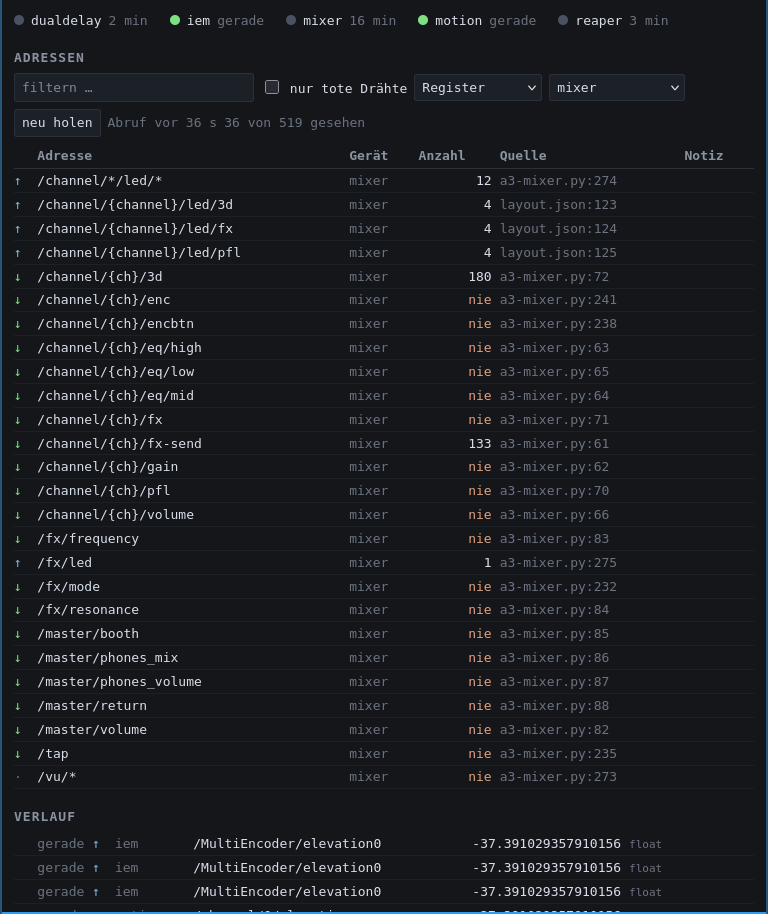
nie in that column: never heard. The window: A³ Core Development.