A³ Motion Development
A³ Motion Controller UI
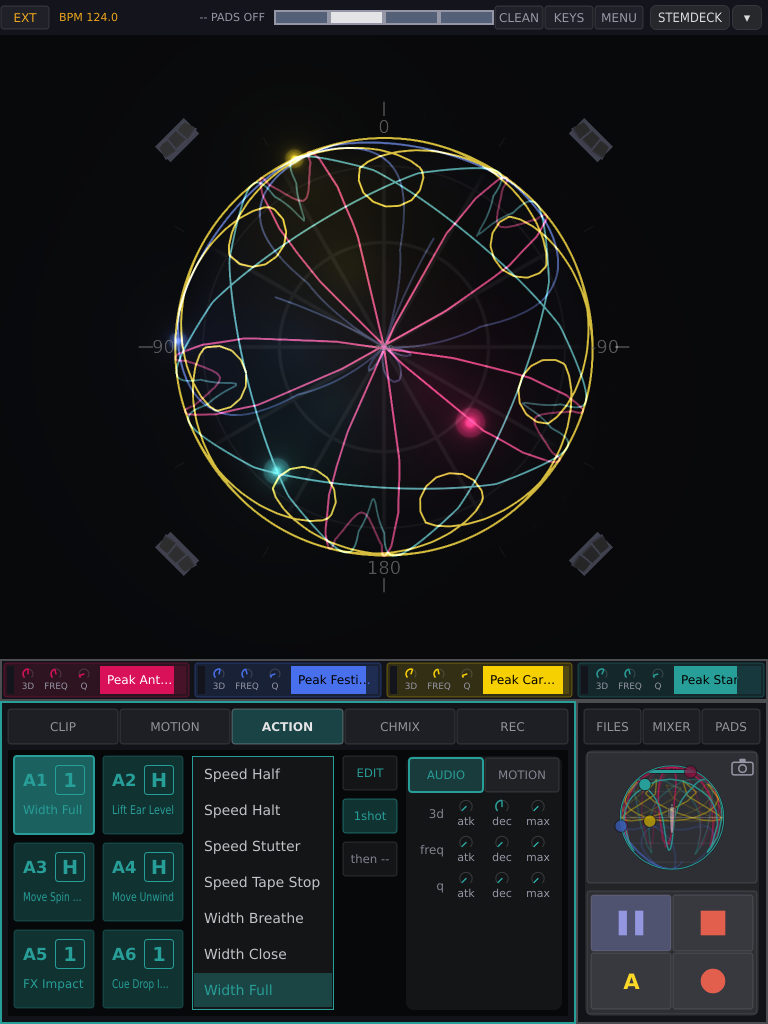
A JUCE / C++17 app drawing the sphere in OpenGL:
a3-motion-ui, the ui submodule of
a3-motion. It records motion from the
touchscreen, stores it as ticks, plays it back on the beat clock, and speaks
OSC to A³ Core. Build and test (./build.sh, ./test.sh, JUCE version):
Building and testing. Hardware: A³ Motion hardware.
Current Version — V03
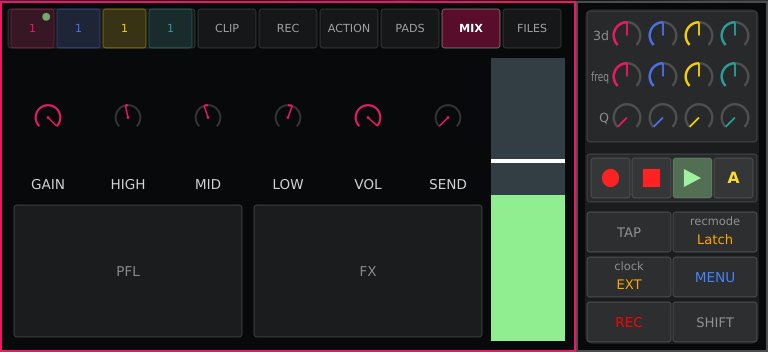
The software mixer
A channel strip like the desk’s plus a summing and filter page, sending exactly the desk’s addresses, so Core can’t tell them apart.
It listens too. Core relays REAPER’s reports; the pages adopt them via
MixerState::setChannelFromPeer, which sets without sending — sending would rebuild the echo loop out of Core’s reach.Three handlers,
onMixerChannelValue,onMasterValue,onFilterValue, each indexing its table inOscAddresses. Master and filter tables are walked after the channel ones:/master/volumeand/channel/1/volumediffer by one word./filter/modearrives as a number (1 = high pass); the desk’s word goes on/filter/led.
Rest positions
A double tap rests a control only where a rest means something. On the strip, only SEND:
constexpr std::optional<float>
mixerControlRestPosition (MixerControl control)
{
  if (control == MixerControl::AuxSend)
    return 0.f;
  return {};
}
A gain snapping to a default mid-set would make a channel jump. The same table
sets the start values; gain and volume start at zero with no rest. The
channel-value strip (channelValueRestPosition): 3d and freq at twelve
o’clock, Q shut (a filter still resonating hasn’t been reset).
Hearing where the sound is
One handler, onChannelValue, accepts five per-channel values from Core:
azimuth, elevation, pot 1, pot 2, 3D. That makes total recall work: at start
the device sends /state/recall, holds its output and adopts the answer
(/state/recall). Output ramps count as primed only after a
tick that actually sent, so a 0.0 start still reaches Core.
The status bar and the signal dots
No VU meters in the status bar: outputs are on the master column, inputs are a dot on each channel’s face.
struct VuDot
{
  bool visible = false;      // false below the meter's floor: silence is nothing
  std::size_t band = vuGreenBand;
  float alpha = 0.f;         // follows the level; the size stays put
};
A warning light, not a meter: a dot has no length to show how far over.
Silence is no dot, not a dim one.
RMS, not peak, or it would flicker on every hit.
Colour from
vuBandColour, the meter’s own rule; a test pins the yellow threshold to the meter’s.Repaint compares the drawn dot, not the level, which wobbles every frame.
Older Versions
The sphere before the touch rework, and before that:


Before


Panel firmware
A microcontroller (hardware) handles buttons, encoders,
pots and LEDs and talks to the UI by a binary poll-frame protocol on USB
serial. PlatformIO project:
firmware/;
build, test, flash: Building and testing.